The Basics: what does self-care look like to you?
In 1943 Abraham Maslow presented his theory of human motivation; a hierarchy of needs. He argued that individuals need to ensure their basic needs (food, shelter, safety) are met before they can explore the more complex ones; stability, belonging, achievement, self-actualisation. All these years later, Maslow’s hierarchy is still cited for the way it encompasses how human beings develop from just surviving to being in a place where they can grow and thrive.
There are so many models in psychology and therapy which look at the same issues, too many to go through in a short blog (I am sure we will touch on many of them as this resource develops) but to introduce this today, I wanted to reflect on the benefits of self-care and begin to think about some of the things that block this from happening,

So many people that I work with have huge demands on them; work, family, financial pressures, daily tasks, seeing friends, life goals. Often just getting through the day without any disasters is a win. I remember when my children were school age, feeling like I was running from one thing to another all day, late for everything and feeling like I was letting everyone down. Self-care felt like a luxury, and I see this same perception in my clients all the time. Even now if I am honest, it is often the first thing to go if I am under a lot of pressure. However, the evidence tells me that this does not help in the long term. Pushing ourselves with little rest, not eating properly, not exercising, people pleasing and expecting too much of ourselves takes its toll over time.
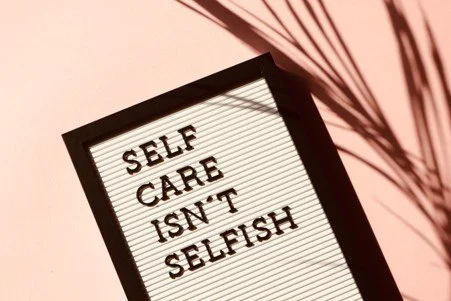
NHS guidance advocates ways of developing and maintaining wellbeing including diet, exercise and sleep advice. I think in theory, many people recognise this now but there’s a big shift between recognising it and addressing it, and this in itself can feel like another task to do – now on top of everything else I am doing, I need to do a park run and have a sauna! If you are assessing a situation from that perspective, it probably will feel overwhelming. This suggests that our expectations of ourselves may play a role in how we think about self-care, for example if I am defining it in these terms, have unrealistic expectations or maybe perfectionist thinking, then perhaps I will feel quite rigid about what this should look like, then if I don’t achieve it, it’s just another thing I’ve failed at!
Cognitive distortions (Beck, 1963) may play a role here. Beck explored these within CBT as common thinking errors we all make, like catastrophising situations, minimising our input or perfectionist thinking. These errors can impact how we assess both situations we are facing, and our ability to manage them. Similarly, Bandura’s (1977) theory of self-efficacy refers to our perception of our own skills and capacity, which could be relevant to why we struggle to manage self-care. Bandura suggested that how much we acknowledge and believe that we can handle a situation and have the skills, knowledge and experience to do so, affects our response. If we think about this alongside any rigid thinking, unrealistic expectations, time poverty, and the sheer exhaustion of our every day lives, it is little wonder self-care drops down the list of priorities?
So how can we use self-care without making it another stick to beat ourselves with? I’m a big fan of self-compassion theory (Gilbert, 2010; Neff, 2023) which encourages kindness and empathy towards ourselves, whilst retaining accountability. In other words, I can take responsibility for myself and what I need to do without berating myself if I encounter blocks. Coming from this stance I can recognise I might want to eat healthily most nights but not give up if I’m too tired to cook one night and get takeaway. Here I am also recognising all or nothing thinking – I have to do it all the time or not at all - and challenge whether this approach is working? I may not have capacity or budget to join the gym, but I could do some stretching while the kettle boils or go for a daily walk or run twice a week. I can build things up at a pace that fits the demands of my life and my capacity at any given time. I don’t have to be all or nothing, I can be flexible.
We can define what self-care is to us; it might be a spa day occasionally for some but for most of us it could be finding time to drink a cup of tea mindfully or relax in the bath before bed. Whatever it looks like is up to you, but anything you choose to do will play an important part in increasing your capacity to meet life’s demands and making self-care a habit. Whatever you choose, I would suggest trying out things until you find what works for you and seeing what difference it makes to how you are feeling. What is one small thing you can do today to look after yourself? Try something out and see what happens! I’ve added links to Paul Gilbert and Kristin Neff’s websites below which have lots more information you might find useful.
Self-Compassion by Kristin Neff: Join the Community Now
Bandura, A. (1977). Self-efficacy: Toward a unifying theory of behavioral change. Psychological Review, 84(2), 191–215.
Beck, A. T. (1963). Thinking and depression: I. Idiosyncratic content and cognitive distortions. Archives of general psychiatry, 9(4), 324-333.
Gilbert, P. (2010). Compassion focused therapy. Individual Therapy, 301.
Neff, K. D. (2023). Self-Compassion: Theory. Method, Research, and Intervention.
Maslow, A. H. (1943). 96. A theory of human motivation. Psychological Review, 50 (4), 370
Maslow, A. H. (1954). Motivation and personality. New York: Harper and Row. Maslow, A. H. (1962). Toward a psychology of being. Princeton: D. Van Nostrand Company.
Maslow, A. H. (1970a). Motivation and personality. New York: Harper & Row.
